Pages

Showing posts with label Work. Show all posts

Tuesday, August 21, 2012

Like most investments, private equity firms are good for the economy


The purpose of every investment – however ordinary or unusual; however simple or complex – is to make money through earned interest or dividends, or profiting from sales of items, services or businesses.

Whether it is a passbook savings account or a Certificate of Deposit; corporate or municipal bonds or shares of stocks; your employer’s pension plan that grows in value to fund retirement; investing in a business and working to have more revenue than expenses; or investing in a private equity firm that buys existing businesses and hopes to build the value of those businesses, profit is the reason people invest.

Nearly everyone understands and accepts that they should collect earnings from a savings account or a stock purchase, but many of these same people are horrified when business owners sometimes make a good living or private equity firm partners make significant money in their activities.

Some seem to think that the purpose of business is to achieve social goals, and try to impose all sorts of their favored ideals on the business world. While many businesses do support community or charitable programs, these are secondary activities. Making a profit so they can remain in business is their primary purpose.

Like every other investment, the purpose of putting money at risk by investing in a private equity (PE) firm is to make a profit, and PE firms do that by buying companies and selling them. They don’t buy successful companies because the price of a successful company is already high, and trying to make a successful company even more successful, and therefore more valuable, is mostly a no-win situation.

Instead, they buy companies that are failing or underperforming, because like a house that hasn’t been taken care of and needs a lot of work, these companies can be purchased at a relatively low price.

Perhaps the company needs to upgrade its equipment or processes; maybe management is stagnant, failing to make good decisions or timely decisions; or it spreads production components too thinly over too many products; or sometimes it must reduce employment to save the company. A fresh look by new owners with particular expertise in what the company does may very well turn it into a profitable entity. That is the bet that private equity firms make.

The firm then uses its expertise to recommend steps to improve the operation and performance, and the company most often prospers, grows, and creates jobs. The improved company is naturally more valuable than when it was purchased, thus the selling price is higher, and sometimes much higher. In three to five years the PE firm would sell the company at a profit, making money for its investors.

This isn’t magic. This isn’t criminal. This isn’t greedy. It is purely logical. And, furthermore, it was the intention from the start, along with producing the positive economic benefits it created and the products and services that it produced to satisfy the wants and needs of consumers.

So, the people investing in private equity firms put their money on the line, risking it on the hope that the firm will successfully buy and turn around poorly performing companies, and sell them at a profit.

However, private equity firms do not always succeed in turning around a purchased company, and in such cases the failed company is closed and people lose their jobs, and yes, the investors lose money.

The private equity folks can’t win. They get criticized as greedy when they succeed in turning around a failing company and then selling it for a handsome profit, and when it fails to turn a company around and the company closes and people lose their jobs, they get portrayed as profit-hungry, selfish capitalists.

What many people do not or cannot understand is the fact that the companies PE firms cannot save likely would have shut down had they not stepped in, and likely much sooner if it had not been acquired. And then there are those who use the pain of lost jobs and closed businesses as opportunities to further their political goals.

This is yet another example of how the American public’s abysmal understanding of how the economy works not only impedes the process of implementing favorable policies that will allow the economy to grow, but also arms demagogues with tools to take advantage of us for their selfish purposes.

There are other facts that need to be emphasized. First, if PE firms weren’t successful most of the time, savvy people would not invest in them. And, private equity investors use their own money in these endeavors, rather than taxpayer money, so no public money is lost in the relatively few times that they fail to turn a company around.

In “American Restoration: The Role of Private Equity,” an article on the Heritage Foundation’s website by J.D. Foster, Ph.D., the author explains that private equity firms “don’t always succeed. But their very existence and the [large] profits they reportedly make testify that they succeed far more often than they fail, and a lot of Americans can thank their continued employment to the prowess of these American restorers.”

Comments are invited

Tuesday, December 23, 2008

Weekly Column: UAW a Major Factor in the Big Three’s Problems

Several years ago U.S. automakers were profitable and life was good. But times have changed, and nearly everybody realizes the UAW’s sweet contract is having substantial negative effects on the industry.

Read the entire article at American Sentinel

Click Here to Comment

Technorati Tags: , ,

Saturday, December 20, 2008

Labor Unions as Villains

Back in the days when employers abused and took advantage of workers, worker organizations were a necessity. Eventually, labor unions emerged and began representing the interests of workers, equalizing them with their employers.

That occurred a long time ago, and since, and to some degree as a result, labor laws have been written that codify the fair treatment that unions once championed alone.

Over the last 20 or so years participation by workers in labor unions has declined substantially, and with good reason: The price of union membership no longer benefits the worker like it used to, because of improvements in employer attitudes, improvements in labor law, and because many states have laws in effect that allow people to work in union shops without joining a union if they so choose.

So, a good argument can be made that unions have outlived their usefulness; they are dinosaurs of a bygone era. Naturally, union bosses and organizations do not want to admit this, and will not just go silently into the night. But their excesses are becoming increasingly unpopular, and the idiocy of some of their practices is beginning to wear thin on the population at large.

For example, as mechanization moved into the auto industry the United Auto Workers managed to get automakers to agree to a monstrosity called a “jobs bank” to protect the jobs of its members who were no longer needed to build cars. This surreal mechanism pays nearly 15,000 workers to not build cars while receiving wages and benefits that often reach $100,000 or more per worker per year. They show up at the plant, or sometimes do volunteer jobs outside the factory, or even take classes, but they don’t build cars. All of the costs of this absurdity help raise the cost of every vehicle produced by the Big Three automakers, adding hundreds of dollars to the cost of your vehicle(s).

Some of the problems involve what are referred to as “work rules.”

Work rules often, perhaps mostly, are designed for the sole purpose of preserving union jobs and creating even more of them. They are often inefficient and even counter–productive.

Here’s one example: My stepfather-in-law once worked in a unionized chemical firm. He told the story about the repair crews employed there. The crews had a supervisor, a pipefitter, an electrician, a carpenter and one other specialist. When a problem arose, a repair crew was dispatched. Didn’t matter whether it was a plumbing problem, an electrical problem or whatever specific problem might exist, a repair crew was assigned to fix it.

He said that often four of the five crew members sat on their butts while one of the others fixed the problem. Why pay one guy to work when you can pay five for the same work?

When the problem was more than the electrician could handle, if he needed someone to hold wires or handle tools, for example, the others were not allowed to assist, another repair crew was summoned, and the two electricians fixed the problem while eight people twiddled their thumbs.

Another incident reported by a manager told of a situation where his company had neglected to ship 100 screws needed in a shipment. He received the call, and instead of being able to go to the bin where the screws lay in labeled bins, he had to find the supervisor wandering the floor in the 5,000 square foot plant, wait for the supervisor to get around to him, tell him what he needed, wait until the supervisor located someone in the correct labor category for getting screws out of storage bins, wait for the worker to count out the screws, then wait while the supervisor found an employee who was in the correct labor category to package the screws, and then deliver the package not to the supervisor, who was standing there, but to the shipping department, where another employee prepared the package for shipment.

A task the manager could have performed by himself in 20 minutes took three hours and involved five people.

Now, there are situations where people who are knowledgeable about wiring need to be the ones doing wiring work because of safety concerns; and there are situations where a worker who knows one screw from another needs to be the one who gets the right screw for the customer, but not in every instance, and maybe lots of instances. But a work rule is a work rule, and if it keeps nine people hired instead of eight or six, then from the union’s point of view, it is a good rule.

Part of the Big Three’s problems are caused by its union, and along with management inadequacies, this one has to be fixed, too.

Click Here to Comment

Technorati Tags: , ,

Saturday, December 06, 2008

Email (lack of) Wisdom

I got this email today, as I’m certain others of you did, also.

“John Smith started the day early, having set his alarm clock (made in Japan) for 6 a.m. While his coffeepot (made in China) was perking, he shaved with his electric razor (made in Hong Kong). He put on a dress shirt (made in Sri Lanka), designer jeans (made in Singapore) and tennis shoes (made in Korea). After cooking his breakfast in his new electric skillet (made in India), he sat down with his calculator (made in Mexico) to see how much he could spend today. After setting his watch (made in Taiwan) to the radio (made in India), he got in his car (made in Germany), filled it with gas (from Saudi Arabia) and continued his search for a good paying job. At the end of yet another discouraging and fruitless day checking his computer (made in Malaysia), Joe decided to relax for a while. He put on his sandals (made in Brazil), poured himself a glass of wine (from France), and turned on his TV (made in Indonesia), and then wondered why he can't find a good paying job In America.”

There are dozens of similar emails floating around that in one way or another point out some shortcoming of the United States, the purpose of which is to cast blame at one segment of our society or another. This one implies that American businesses have abandoned the American worker in favor of cheaper foreign labor.

These messages are aimed at eliciting an emotional response, and deliberately ignore legitimate reasons for why Joe’s scenario is true.

For example, Joe made a conscious decision to buy a German car, choosing one of them over an American auto. Why did Joe do that? Maybe it’s because other countries are better at some things than America; German automobiles are some of the best in the world.

Joe also bought French wine instead of one of the hundreds of fine American wines.

Fault the writer of the email for faulty logic.

Maybe the reason we don’t make many of these products here any more is that we can’t make them economically any longer. After all, one thing Americans want is the lowest prices they can find, and businesses, in order to remain competitive must keep costs low.

The labor rate of many emerging economies is vastly lower than in the U.S. In Sri Lanka, for example, an assembly line worker may be thrilled to make $1 an hour, where in the U.S. by law a worker doing the same job must be paid at least $6.55 and hour, and if that worker belongs to a union, the rate would be substantially higher. Union workers make on average 12 percent more than workers doing the same work who are not unionized.

People seem not to realize that if businesses pay higher wages the price of their product has to go up commensurately. They also focus on the idea that all jobs should pay a “livable” wage, whatever that is.

But the economics of business operations turns that argument on its head. A job has a value that has nothing to do with the price of food, shelter and clothing; wages are based upon the value of the work done. Sweeping floors does not pay as much as brain surgery. Filing papers does not pay as much as designing a new computer chip. A person who runs a shift of carpenters does not earn as much as the person who runs the home building company.

Each business has to determine what it can afford to pay for different types of work, what it can afford to pay for raw materials, what it can afford to provide in the way of benefits and other factors, and still be able to price its product or service competitively, and still have something left over for investors.

Workers have the option to not take or keep a job if they believe they are underpaid or just don’t make enough to live on.

Businesses will try to find the best people to perform the various work they need. If a business pays low wages in all or some jobs, eventually they won’t be able to hire enough people, or good enough people to get the work done and will either have to pay more, or go out of business.

But if the American consumer is going to enjoy low- or acceptably-priced goods and services, businesses must be allowed to find the least expensive competent labor they can, even if that means going outside the U.S.

Click Here to Comment


Technorati Tags: , ,

Tuesday, November 18, 2008

Big Three Automakers Would Fair Much Better in a True Free Market

Following the sub-prime mortgage banking crisis of a few weeks ago we are now confronted by a financial crisis that threatens the Big Three automakers, GM, Ford and Chrysler. Detroit’s difficulties are somewhat the result of the business practices that have not changed with the times, outdated product lines, so-called “legacy costs” leftover from the golden age of the industry in the form of costly pension and health care plans for retired employees that contribute billions of dollars of expense, and other difficulties.

Like the sub-prime crisis, however, the auto industry problems have been complicated by policies of the U.S. government. The industry, like all businesses, suffers from high costs of taxation. Taxing business raises prices to American consumers. Yet the tax-and-spenders in Congress cannot understand or will not admit that fact, and continue to maintain that corporations must pay taxes without caring that this makes it harder for their constituents to buy the things they want and need.

In theory, businesses in a free market succeed or fail on their own merits. It is a simple equation: Auto makers make money by producing vehicles and selling them for more than the cost of producing them. When left to work without much interference, it works pretty well. But when the government gets its fingers too deeply into the business of business, as it invariably does, all manner of weird things can happen.

The most significant factor in driving the Big Three to the brink of financial collapse, however, is the United Auto Workers union contract, which contains barriers to cutting costs and downsizing to profitability. Import autos put downward pressure on the price of domestic autos, while high wages, benefits and other elements of the UAW contract put upward pressure on the costs of production, and ultimately cause prices to be high and uncompetitive or, if prices are kept artificially low to be competitive, the companies are unprofitable.

Unions are not universally bad, but some of their practices are reckless and wasteful. The UAW demands are a substantial obstacle for U.S. auto manufacturers that foreign companies do not have to deal with. The vast difference in labor costs between the Big Three’s expensive union workforce and lower-priced non-union workforces-about $25 per hour on average-means that U.S. automakers lose money on every vehicle produced in their northern union shops, while Toyota, Nissan and Honda make money on each vehicle manufactured in non-union southern shops.

By holding labor strikes over the heads of auto companies, the UAW has managed to get them to agree to a monstrosity called a “jobs bank,” a surreal mechanism that pays nearly 15,000 workers to not work building cars while receiving wages and benefits that often reach $100,000 or more per worker per year. Many of these workers do volunteer jobs or go back to school, but the rest must clock time doing nothing at the workplace, and all of them collect a paycheck and waste their employer’s money. Every dollar wasted by the jobs bank adds to the cost of American made vehicles, making the Big Three uncompetitive or unprofitable, or both.

How does the government figure into this idiocy, you may be wondering? Well, government policies favor labor in the labor/management relationship. Belonging to a labor union is a collective decision, rather than a personal decision. If you work in a place with 100 employees and 51 of them vote for union representation, in order to keep your job you must become a union member, even if you voted against the union and don’t want to join. And federal labor laws support this situation. Unions are now promoting so-called “card check” measures in both houses of Congress which would eliminate the sanctity of the secret ballot method of voting for or against union representation. More government meddling in “free market” business operations.

There is strong opposition to the bailouts proposed by the federal government to correct these various economic crises, a major argument against which is that businesses should survive through smart decision making, not through government assistance. If bad business practices have put them where they are today, let them fail, or let them restructure, but government ought not to help them correct these problems.

This view is grossly hypocritical: It takes the position that government must be neutral when the Big Three automakers are in trouble, but ignores government’s role in making it so much more difficult for them to succeed.

Government bears more than a little responsibility for the problems the automakers now face, as it does in the sub-prime mortgage crisis. So it is a fair question to ask if the government does not have a measure of responsibility to help fix the problem.

The federal government is too big, too expensive and too intrusive. Americans ought to demand that government stay out of business operations, except for setting broad principles to guard against abusive practices, and leave them alone to truly succeed or fail on their own merits.

Stop punishing consumers through corporate taxation.

Stop over-regulating business operations. Get out of the way and let employees and employers work out the terms of employment between them.

Click Here to Comment

Tuesday, May 06, 2008

CHOICES: A Program to Aid Young People in Finding Their Way

An organization of which I am a member is participating in the CHOICES program to talk with 9th grade students for about an hour on two successive days about their future. So, on the night of the North Carolina and Indiana Democrat primary elections, I am studying how to present this material to these young people the next two days.

I attended the training session on Monday, expecting to have at least a week before I was thrust before these young people. But, as fate would have it, I ended up with only two days to get ready, and really only one day, as I found out today that tomorrow is the day. Since I am trained as a teacher, I suppose I have a couple of steps on someone who hasn’t had that experience, so I guess I ought to quit complaining and get busy reviewing the materials.

I am looking forward to this experience, and I think it will be a positive thing, both for the students and for me, but I really wish I had more prep time.

Friday, December 07, 2007

Sometimes, Life Gets in the Way

I visited Buffalo’s Ruminations recently, as I do nearly every day, and found that my ol’ buddy was whining again about how uncomfortable he is in wonderful Friendly Manitoba. Buff seems to think that 25 below is a problem. Some people just can’t be happy. So I’m taking a cue from Buff and seeking sympathy from my gang, as he was from his.

Here’s my schedule for this week:

Sunday: Layout and prepare print job for printer; work on 900-name mailing list for event on Dec. 28 (fairly easy day)

Monday: deliver job to printer; work on agenda, etc. for 11 a.m. meeting tomorrow at which I am, as Mr. Bush might say, the “presider;” work on agenda, etc., for meeting at 12 at which I am, again, the presider; read notes and prepare for board meeting tomorrow at 5:30 at which I am merely an “attender;” in between, work on mailing list for event coming up on Dec. 28; conduct rehearsal for group with concert on Sunday, find out I have a challenging solo that no one else wants to play, finished at 9:40 p.m.

Tuesday: Complete prep for meetings at 11 and 12; practice for solo no one else wants to play; be the presider at the 11 o’clock meeting; be the presider at the 12 o’clock meeting; be an attender at the 5:30 meeting; in between work on details of next Wednesday’s annual dinner of another organization I am involved in; 6:00, attend annual dinner of local business organization; get home at 9:50

Wednesday: preliminary work on the newsletter and Web site update due Thursday; attend holiday reception as representative of organization; work on details of next week’s annual dinner; be attender of, and involved in reception at 5:30 for potential members of organization for which I was presider yesterday; perform in hand bell group I am a member of at 6:15; rehearse with group for Christmas cantata following hand bell performance, finish up at 9:30 p.m.

Thursday: Complete newsletter and Web site update (aprx 4 hours); 1:30 confirm arrangements and equipment transfer for Sunday concert/Thursday dress rehearsal; attend to details for next week’s annual dinner; dress rehearsal from 6 ‘til 9:15, including setup, rehearsing band, and playing solo that no one else wants to play (NOEWTP)

Friday: 9:00 a.m., practice for cantata and solo NOEWTP; work on details of annual dinner for next week at which I must give annual report and introduce the Governor of West Virginia; cook dinner and enjoy an evening and some wine with my wife

Saturday: Work on decorating the house; practice for cantata and solo NOEWTP; work on mailing list for event on Dec. 28; copy and fold programs for tomorrow’s concert; try to relax a little

Sunday: 9:30 a.m. prep for 10:30 hand bell performance; 11:45 aprx, lunch for hand bell choir; 1:00 setup for concert; 1:30 warm-up for concert; 2:30 concert; 4:00 rehearsal for cantata; 5:30 or so, home

Next week has its challenges, but isn’t as full as this week.

Don’t you feel sorry for me?

It’s not so much that I’ve been busy, although I certainly have been, but there is a lot of responsible attached to these activities, which is stressful. But the worst of it is that I just haven’t had much time for writing and visiting other sites. That is the real shame of all this.

Saturday, March 31, 2007

‘Twas Guy’s Fault

I feel better now. Through a great deal of thought about my water pipe tragedy last Wednesday I have come to realize that it really wasn’t my fault at all, it was my friend Guy’s. You see, normally on Wednesday he and I have lunch and discuss issues with an organization we are both involved in, but this particular Wednesday he had a conflict.

Now, if I had been going to lunch, I would have showered and dressed for activities other than yard work, especially since I had a formal meeting at 5:30 p.m. What sense would it have made, after all, to get all cleaned up for lunch, come back home at 1:30 and get all dirty working outside, then have to get cleaned up again in only three hours? Not much, unless the yard work was really pressing, and it wasn’t that pressing.

So, thanks to Guy, my nasty water event happened on Wednesday.

No, I haven’t forgotten that it was my negligence that led to the pipe bursting in the first place, but it was only happenstance that caused that rupture to be recognized Wednesday, and there was always the chance that I might have realized (when I saw the hose still connected) that there was a good chance the pipe had burst over the winter, and I might have checked it out before needing to use the hose to control a fire. That’s my story and I’m … well, you know the rest.

Rationalization is a wonderful thing. I feel so Liberal!


Technorati Tags: , ,

Wednesday, March 28, 2007

Not a Great Day

I had some tutoring this morning and a couple of phone calls to make, then I planned to get outside and start reclaiming the yard from the natural havoc that occurred over the winter. You may remember my saga of the leaves? Well, there are still plenty of leaves left, even after the dozens of cubic yards of them that I removed in the multiple battles last fall. I had already had a short bout with some stuff along our walkway on Sunday, and I was ready to dive in for as much time as I could squeeze in before the predicted rain began. It started out as a very nice day, rising into the 70s (fourth straight day of that) and sunny.

So, out I went, first to clear the driveway of the gravel from the town’s snow treatment and some other stuff that had gathered there. I broke for lunch and finished the driveway right after. I then headed for the area behind the back deck, which is a series of tiered planting areas with a bunch of azaleas and some other shrubs, part of the Grand Design of the Master Leaf Catcher from whom we bought the house. I didn’t get all the leaves picked up, but I did get them cleared from the plants so they could begin their spring development. We have a few plants around that are some kind of ornamental grass. It grows tall and then turns almost white when the season is over, almost like straw. One of those, the biggest one, is out front near the street, and it was six to seven feet high. One night last week before my son Ryan headed back to college, we lit that sucker and watched it burn. It is quite spectacular (which is why we did it, and why we did it at night). There is also a good-sized one of those in the planted area out back.

Because of the torture that is the leaf removal process I have toyed with the idea of burning the area clear. That thought crossed my mind today. The grass in question is at one end of the planters, so I figured I’d give it a shot. Now, I knew that this would be quite the conflagration, and I knew that the flames would singe the timbers that the planters are built from, but they need to be painted/stained anyway, so I was willing to let them get scorched in order to see how effective/destructive the burning method would be.

So, with a garden hose connected close by, I lit the grass. It went fast. I knew it would. It caught the leaves nearby on fire. I knew it would. Pretty soon, the fire had spread to an area I thought was plenty big, so I fetched the hose to keep the fire from going beyond those boundaries. I turned on the faucet and climbed up near the burning area and began to water the perimeter to keep the fire within it. A really pitifully weak stream dribbled out of the nozzle. “That’s weird,” I thought, and headed down to the faucet. As I climbed down, I noticed that the fire, as fires are wont to do, was spreading. Quickly. I got to the faucet and realized I hadn’t opened it all the way. “That’s the problem,” I thought, and headed back to where I had laid the nozzle down, picked it up and began to spray the perimeter again, which was now larger than intended, but not (yet) out of control; the woods were not far away. The stream was only a little better, but enough to take care of the immediate problem, so I continued watering the perimeter. When that was accomplished, I went back down to the faucet; some burning continued. I tried the faucet and found it was wide open. Then I saw it: water dripping from beneath the sideboards on both sides of the faucet. “This isn’t good,” I said. I had to take care of the other burning areas, which took a few minutes, and then headed for the basement where the pipes came through the wall.

I opened the door to the back part of the basement where we have a lot of stuff stored and looked straight across to the wall where the pipe is. I saw a little trickle of water rolling down the wall. Then I turned on the light. It didn’t take long to realize that there was about a half-inch of water covering the floor. The entire floor. I ran to the main cutoff valve and shut off the water supply. Damn! I was angry. What a mess. Now, instead of making progress outside, I had to shift my focus to cleaning up water inside the house.

I won’t bore you with the gritty details of the clean-up, except to say it was, and is, a giant pain, but I will tell you one thing more: It was all my fault. I had neglected to take the hose off the faucet before winter weather set in. I know better; I just didn’t do it. I’m really peed off!!!

Lesson learned.


Technorati Tags: , ,

Friday, January 05, 2007

NEWS BULLETIN from Denver


Up here, in the "Mile-Hi City," we just recovered from a Historic event—may I even say a "Weather Event" of "Biblical Proportions”—with a historic blizzard of up to 44 inches of snow and winds to 90 MPH that broke trees in half, knocked down utility poles, stranded hundreds of motorists in lethal snow banks, closed ALL roads, isolated scores of communities and cut power to tens of thousands.


For the record:

  • George Bush did not come.
  • FEMA did nothing, and wasn’t expected to.
  • No one howled for the government.
  • No one blamed the government.
  • No one even uttered an expletive on TV.
  • Jesse Jackson or Al Sharpton did not visit.
  • Our Mayor did not blame George Bush or anyone else.
  • Our Governor did not blame George Bush or anyone else, either.
  • Nobody demanded $2,000 debit cards.
  • No one asked for a FEMA Trailer House.
  • No one looted.
  • Nobody - I mean NOBODY - demanded the government do something.
  • Nobody expected the government to do anything, either.
  • No Larry King, No Bill O'Rielly, No Oprah, No Chris Mathews and No Geraldo Rivera, No Shaun Penn, No Barbara Striesand, No Hollywood types to be found.


Nope, we just:

  • Melted the snow for water;
  • Sent out caravans of SUV's to pluck people out of snow-engulfed cars;
  • The truck drivers pulled people out of snow banks and didn't ask for a penny;
  • Local restaurants made food and the police and fire departments delivered it to the snowbound families;
  • Families took in the stranded people - total strangers;
  • We fired up wood stoves, broke out coal oil lanterns or Coleman lanterns;
  • We put on extra layers of clothes because up here it is "Work or Die;"
  • We did not wait for some affirmative action government to get us out of a mess created by being immobilized by a welfare program that trades votes for “sittin’ at home” checks.


Even though a Category "5" blizzard of this scale has never hit this early, we sometimes have blizzards and we know how to deal with them ourselves.

That is a good lesson for the rest of the country.

Tuesday, December 05, 2006

It’s Been Really Busy Lately

November was a blur. We headed off on our Southern Odyssey on the night of the 7th and returned at 1 a.m. on the 20th. For us, that’s a long trip. It was a great time, but getting ready for a trip of that length is a challenge, and catching up after a trip of that length is more of a challenge.

It was the week of Thanksgiving when we returned, and my regular Tuesday Rotary Club meeting (that I am Program Committee Chairman of) occurred, and that night a Foundation where I serve on the Board had its fund raising dinner with magician Michael Ammar as the entertainment. Michael is a world-renowned magician, and a hometown boy. He was amazing, and that’s a word I don’t use frequently. I also had some online tutoring Tuesday morning.

Wednesday, I had more morning online tutoring, and a meeting Wednesday evening; Wednesday was the easiest day of the week, as it turned out. Thursday, we traveled two hours north to spend Thanksgiving Day with Diane’s mother, who had just moved back to the home where Diane and her two brothers grew up, the first time the family had been together in that house in 26 years. That was very special for them.

Friday, the newsletter for the Rotary club was due to be posted and the Web site updated, and that’s a task that lasts several hours. Then, thank goodness, it was the weekend. That didn’t mean there was nothing to do, but less of it: the Battle of the Leaves in the day, and a party that night. Sunday, the kids headed back to school and then I played a rehearsal for the church Christmas cantata that night.

And then on Monday, the Week from Hell Began. Tutoring morning and afternoon at the college; and in the evening a rehearsal of the jazz ensemble that I’m director of had its second rehearsal before our Winter Concert. Predictably, there were many things not right in the concert hall. Tension. However, the rehearsal went pretty well, and playing music is always fun and therapeutic.

Today, it’s Tuesday again, and in addition to the online tutoring there’s the regular Rotary meeting at 12, and I have a meeting with some folks from Georgia—the country, not the state—for the Foundation at 11, and also a Board meeting for Rotary at the same time. I’ve got to finish setting up an invitation that our family (the big family, not Diane and I) sends out to nearly 900 people and get it to the printer. Tonight, thankfully, there’s our weekly get-together with some friends for dinner.

Wednesday: online tutoring and then cantata rehearsal in the evening. In the afternoon I’ll be setting up the concert program, and I have to get a head start on the newsletter and Web site update, because Thursday is filled.

Thursday: Dress rehearsal for the jazz ensemble concert at 7, meaning a few hours checking out equipment and working out details, and somehow finish and post the Web update material.

Friday: Run off and fold the programs, and take care of final details. A light day.

Saturday: We may have a called cantata rehearsal, otherwise, nothing scheduled, thank the Lord. Maybe work on the leaves again.

Then, Black Sunday: First cantata performance at 10:30. Warm-up for jazz ensemble at 2, and the concert at 3. At 4:30 the second performance of the cantata is scheduled. Problem: the jazz ensemble concert won’t be finished by then, so the two of us involved in both groups will have to get to the cantata as soon as we can, arriving after the performance has begun. But by 5:30 or so, it’ll all be over.

Monday begins a regular week, but after the previous one, it will be a snap.

Sunday, November 26, 2006

The War of the Leaves, Part II

Well, this is the second installment of my report from the front in the annual fall struggle with nature, although Saturday was the fourth battle in the long, hard slog to clear the multitudinous leaves from the grounds of our humble abode. This time, I have real photos of some of the prisoners taken (the photo at left is not of our house, although we have more leaves than the pile in the picture).

It was a hard afternoon, though it would have been difficult to find a more pleasant one: mid-60s and sunny. But I put in three hours of climbing around moving the leaves into piles and I decided I had earned myself a rest. So, at 4:00 p.m. I was out on the front porch cooling off. There’s something special about just kicking back with a good libation. Corky, our Beagle mix, was cooling it, too, sitting on the edge of the hill overseeing her domain. The squirrels were busy doing whatever it is squirrels do at this time of year. It was very pleasant.

We’ve approached this project in different ways over the five years we’ve been in this house. The first two Diane and I personally took the project on with a rake and trash bags. It wouldn’t be so bad if we had a level yard, or even one with some trees in it. But no, when we bought this house, shortly before the onslaught of the leaves in 2001, we thought being surrounded by trees on three sides was an asset. And they are in the spring and summer when they pretty much shield us from the rest of the world, except on the fourth side, which looks across the street over our neighbor’s roof at the mountain in the distance. But after the leaves fell and we realized how much trouble we were in, it was too late.

The folks we bought the house from, Ray and Lois, were very nice people, and they had built a nice little house on their double lot. The problem is that they had to carve out level land for the house to sit on from a substantially slanted hill and in doing so left a steep bank in the back of the house. Now Ray is an engineer, and he used his skill to design a series of tiers with landscape timbers and rocks to hold that bank, and in those tiers he put every conceivable type of flora that catches and holds leaves in the fall: You name it, Ray put it in. I’ve cursed him every year sometime during October.

Twice we had people come in and do the work for us, but they didn’t do it like we wanted it done, and they were expensive. So this year, it’s up to me and this year I decided to try a new approach. Instead of raking the leaves, a process that takes about 25 hours of work, I bought a new leaf blower/vac. I already had one, a gasoline model, but it just wasn’t up to the task. This new baby is a Black and Decker electric model that produces a 230 mph breeze that moves the deck furniture.

The Big Wind Storm and Small Wind Storm blew through the area in October. The Big one packed winds approaching 60 mph and the Small one packed winds of only 40-45 mph. Dozens, perhaps hundreds, of twigs and limbs—some of which are stout ones—were blown down by these storms, and these twigs and limbs get mixed in with the leaves and get caught on things and generally make a difficult job worse. Unfortunately, the wind only blew more leaves into the yeard, and didn't blow many out of the yard. The rain and snow made the leaves wet, compounding/confounding the work to be done.

The process is to get the leaves off the hillside tiers and onto the deck, then off the deck behind the house, and then blow them across the yard and over the hill into the woods. This photo shows one pile of leaves that is behind the house that is about 13 feet long, five feet wide, and 3-or-so-feet deep. That’s the second pile like that I gathered up Saturday, and it’s the eighth one this fall. Say what you will: That’s a lot of leaves! I’ve got at least three more piles that size to go, and then I get to move to the front yard.

Compared to the back of the house, though, the front is a breeze. I knnow that I have everyone's sympathy! The good news is that the war will soon be over for another year.

Technorati Tags: , , , ,

Monday, October 23, 2006

The War of the Leaves

Fall is a beautiful time of the year, with all the colored foliage, the crisp, cool air, and all that goes with it. But fall also brings with it the specter or war and all its ugliness.

It was October 14, 2006, the day of the first battle in the War of the Leaves. It is an annual conflict of reasonably large proportions.

Our double lot is fairly large, about two-thirds of an acre, but most of it is wooded, so the yard itself isn’t very large; it takes only about 20 minutes to mow the grass. Even with the weed eating added in it is less than an hour’s work most of the time. So, even though there are dozens of deciduous trees on three sides of our house, and even though those trees produce hundreds of thousands of leaves each year, clearing the yard of leaves each fall shouldn’t be a big challenge. Right?

Well, no.

The man who built and owned this home before we bought it was an engineer. He used his talents to do a couple of good things to the house, including designing and implementing a series of tiers out back behind a rock wall that lines the deck so that the steep hillside won’t slide down onto the deck, but he also selected and planted or installed every conceivable piece of flora and devices to catch and hold leaves after the fall from the trees.

So what should take three or four hours of raking/blowing/vacuuming takes far longer. In the past clearing the thousands of leaves around our humble abode has taken me and the boss 25 to 30 hours of manual and tool-assisted labor. We rake, we use the blower, we use the vacuum, we hand pick leaves out of the numerous plants. The weather is an additional factor, of course. Sometimes it's cold. Sometimes it's wet. And sometimes the wind blows the leaves back where they were before we gathered them into piles. The little good news about this ordeal is that once the leaves are accumulated, instead of having to bag them up we can just rake or blow them into the woods on the downside of the hill. And, there's the exercise element. I suppose all that activity is a good thing.

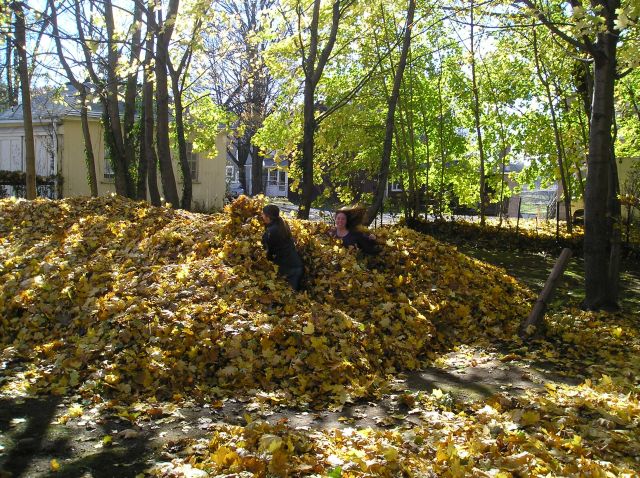
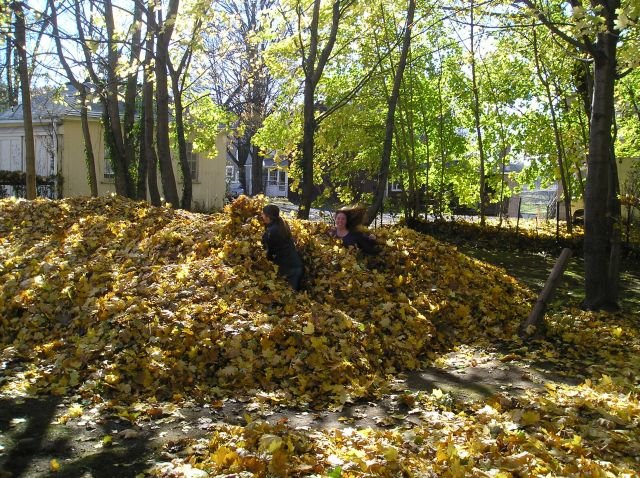
Incidentally, neither of these photos is of my yard, but the lower photo gives you a good idea of what we face each year.

So it is with not much enthusiasm that I look ahead to the successive battles in the War of the Leaves. I know I have everyone’s sympathy.

Technorati Tags: , , , ,